

Second stage

Second stage

Close up of a woman holding her new born baby This stage of labour starts when your cervix is ten centimetres dilated, and the baby’s head is moving into the birth canal. This is normally accompanied by a pressure in your bottom, followed by an urge to push which can feel difficult to control and similar to the sensation of needing to open your bowels. Some women may not get an urge to push, particularly if they have an epidural. If this is the case, your midwife will help guide you by feeling for a contraction on your abdomen and letting you know when to push. Your midwife will check your baby’s heartbeat regularly and support you to try different positions. When your baby’s head is nearly born, your midwife will encourage you to gently breathe and avoid pushing if possible. This ensures your baby’s head stretches your perineum slowly and can help reduce tearing. The second stage of labour ends with the birth of your baby. This stage of labour can last up to four hours if it’s your first baby, and is usually much quicker if it’s your second or third baby.
Positions for birth

First stage

First stage

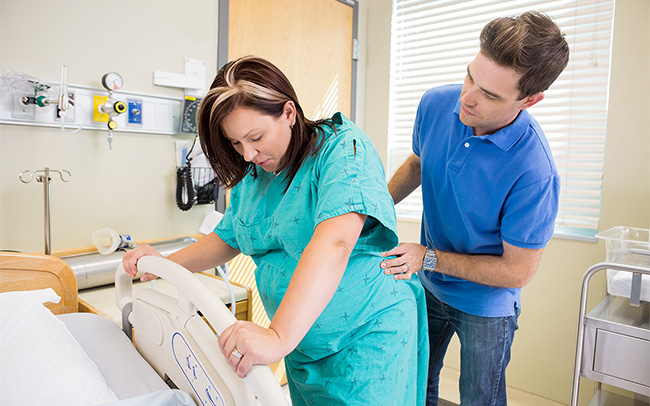
Heavily pregnant woman stands holding the end of a hospital bed with her birth partner standing behind her holding her waist Active labour is often said to begin when contractions are strong, regular and lasting at least 60 seconds, and your cervix is open to at least four centimetres. During the first stage of labour your contractions will continue to come regularly, and become progressively stronger. This stage of labour can last around 6-12 hours if it is your first baby, and is often quicker if it is your second or third baby. When you arrive at your maternity unit (or your midwife comes to your home) and throughout the first stage of labour your midwife will offer regular assessments of your progress and wellbeing, and the wellbeing of your baby, including:
  • your observations (blood pressure, pulse and temperature)
  • abdominal palpation
  • listening to your baby’s heartbeat
  • vaginal examination to assess the progress of labour and position of your baby.
Your midwife will support you with different positions and coping strategies, including pain relief if needed. If the midwife is concerned about you or your baby at any point, they will ask a senior midwife or obstetrician for a second opinion. This can sometimes mean transferring to the labour ward if you are at home or in a midwifery led unit. Towards the end of the first stage you may experience something known as ‘transition’ which can make some women feel scared or out of control. This is common and is soon followed by an urge to push as the cervix reaches ten centimetres dilated, and the baby moves down into the birth canal. Your midwife will support you closely during this stage.

Early labour/latent phase

Early labour/latent phase

Heavily pregnant woman lies on her side in bed Early labour (sometimes called the latent phase of labour) can last anything from a few hours to a few days. In this time you may have periods of regular contractions, followed by periods of irregular contractions that can even stop for a few hours. During early labour your cervix will go from being thick, closed and firm to being soft, thin and stretchy. This change enables the cervix to start opening.

When to call your midwife/maternity unit

When to call your midwife/maternity unit

Heavily pregnant woman kneeling on her bedroom floor and leaning over with one elbow on her bed Call your maternity triage/assessment unit OR Birth Centre if:
  • your waters break
  • you have any fresh red vaginal bleeding
  • your baby is not moving as often as usual
  • you have strong and regular contractions
  • you have constant abdominal pain
  • you feel unwell or you are worried.

Your waters breaking

Your waters breaking

Close up of a pile of sanitary pads The amniotic sac is the fluid filled bag that your baby grows inside during pregnancy. This sac will break before your baby is born. When it breaks, the fluid will drain out from the vagina. Most women’s waters break during labour, but it can happen before labour starts. If your waters break, you may feel a slow trickle or a sudden gush of fluid. This fluid is normally clear or pink in colour, however sometimes a baby can pass their first poo (called meconium) inside the sac, causing the fluid to become green or yellow. If you think your waters have broken it is important to call your maternity triage/assessment unit straight away, particularly if you think you can see meconium. If you are less than 37 weeks pregnant this may be a sign of premature labour. If you think your waters have broken, wear a thick sanitary pad as your midwife will ask to see this when you attend your maternity unit for a check-up. You can also take a photo of the initial loss of fluids as this can help with assessment. Make sure you take plenty of pads and a change of clothes with you on your journey into the maternity unit as, once the waters have broken, you will continue to leak amniotic fluid. If your waters do break before labour starts, you will be offered induction of labour (IOL) to reduce the risk of infection for both you and your baby. Induction can be immediate, delayed until 24 hours, or expectant management. Expectant management (waiting for labour to start spontaneously) beyond 24 hours is not recommended in current national guidance.

Contractions

Contractions

Heavily pregnant woman kneeling on her bedroom floor and leaning over with one elbow on her bed When early labour (sometimes known as the latent phase) starts, you may experience irregular contractions that vary in duration and strength. This can sometimes last for a few days, and it is important to rest when you can until they become regular. When your contractions become strong and regular, it may be helpful to start timing them (approximately how often they are coming and how long they last for). If it is your first baby, you will normally be advised to come to the maternity unit when your contractions are every three minutes and lasting for 60 seconds. If it is your second or subsequent baby, you may be advised to come to the maternity unit when your contractions are every five minutes and lasting for 45 seconds. You can call your maternity unit for support at any time, and a midwife will advise you on when to come to the maternity unit. If you’re planning a homebirth, your midwife will come and visit you at home at the appropriate time. Many women find trying different positions, walking, a warm bath, distraction and relaxation techniques, massage and resting in between contractions useful when at home. It is important to have regular light snacks (even if you don’t feel hungry) and to sleep when possible. It is also important to drink, taking regular small sips of fluids in order to remain hydrated. You don’t need to drink more than you would normally.

The ‘show’

The ‘show’

Close up of crumpled loo paper sheet with a slighty blood stained jelly-like substance in the centre During pregnancy, a plug of thick mucus forms in the cervix, and as the body prepares for labour this plug may pass out through the vagina. This can happen one to two weeks before labour, during labour or sometimes not at all. It appears as a clear or pink/slightly blood stained jelly-like substance, and you might notice it once or on a few occasions. You don’t need to call your midwife about this unless you are worried, however if you notice that it is heavily blood stained or that you are losing fresh blood, call your maternity triage/assessment unit straight away.

Early signs of labour

Early signs of labour

Close up of a pregnant woman propped up in bed holding her the sides of her bump In the week building up to your labour starting you might experience some of the following:
  • increased clear vaginal discharge
  • mild upset stomach or diarrhoea
  • feeling energetic or restless
  • frequent practice contractions, or tightenings of the uterus known as Braxton Hicks, and/or backache.
Some women won’t notice any of these signs, and it is nothing to worry about if you don’t feel any different towards the end of pregnancy. As your labour starts you may notice some of the following signs which can be explored here.
How will I know I am in labour?

Information for partners (preparing for birth)

Information for partners (preparing for birth)

Pregnant woman washing up at a kitchen sink with a man standing behind her holding her affectionately

Before labour and birth

It is important to discuss with your partner your role as birth partner and how you feel about being present at the birth. You can write a birth plan together and support her if it needs to change for any reason. You can also:
  • make sure you can always be contacted in the final weeks
  • arrange how you’ll go to the maternity unit, if you are planning on having the baby there
  • ensure the car always has fuel and ensure you have tested fitting the car seat. You can keep the car seat in the car
  • do a trial run to test your route to the maternity unit, and ensure you have small change for parking meters
  • help pack the maternity unit bag and make sure you pack the things you need
  • think about preparing/freezing some meals for after the birth so you don’t have to worry about cooking when first at home
  • learn about what to expect so you can be as prepared as possible to care for your partner and baby read the sections on:

Preparing for after the birth

The birth can often feel like such a huge event that not much time or attention is given to fatherhood and parenting. Having a baby changes relationships, carries responsibility and has significant financial impact, whilst also being a time of intense joy and pride. Up to 10% of new dads can suffer from postnatal depression, so if you start to feel changes in your mood, talk to your family, friends and GP (and see here).
Portal: Information for partners