
Safety in NHS services

Safety in NHS services

NHS logo This document outlines some recent NHS initiatives aimed at maximising safety, whilst keeping quality of care at the centre of maternity services. This will help you understand how care is designed and how you can seek more support.

NHS Long Term Plan (2019) aims to:

  • Improve access to support for mental health with the same urgency as physical health for birthing people, their partners and families. Look out for local information in the app or speak to your healthcare professional.
  • Improve safety for baby through the NHS England Saving Babies’ Lives Care Bundle standards, by:
  • 1. Offering choice and personalised care with respect for autonomy and decisions.
  • 2. Offering support to reduce smoking.
  • 3. Undertaking risk assessment and appropriate management of babies who might be at risk of growth restriction (slow growth).
  • 4. Informing pregnant people of the importance of promptly reporting a reduction in baby’s movements.
  • 5. Undertaking effective monitoring of the baby’s wellbeing during labour and birth.
  • 6. Reducing the number of preterm births and optimising care when preterm delivery cannot be prevented through:

a) Prediction

  • Undertake a risk assessment and refer to the low, intermediate or high-risk pathway and develop a personalised care plan for the birthing person.

b) Prevention

  • Assess if aspirin is required from 12 weeks of pregnancy.
  • Support to stop smoking.
  • Offer a urine test at the first antenatal appointment (Booking appointment) to screen for urine infection. If treatment is indicated, a repeat urine test should be taken to ensure infection has cleared up.

c) Preparation

  • Optimise place of birth to ensure that birth occurs in a maternity unit that has the appropriate neonatal care services to support your baby.
  • Birthing people are offered corticosteroid injections between 24 and 33+6 weeks, optimally at 48 hours before birth. This is to reduce the risk of your baby having breathing difficulties, gut problems, or bleeding in the brain.
  • Birthing people who are in established labour, or who are having a planned preterm birth within the following 24 hours, are offered magnesium sulphate infusion between 24+0 and 29+6 weeks of pregnancy (or considered for this infusion between 30+0 and 33+6 weeks of pregnancy) to reduce the risk of cerebral palsy in babies.
  • Improving general health outcomes for you and your baby. NHS England is funding a 6-8 weeks mother’s health check with your General Practitioner (GP)in addition to the baby check to assess your ongoing health and wellbeing needs.

Ockenden Report (2020)

This report aims to improve safety for you through pregnancy and post-birth through:
  • Enhanced safety in maternity units by undertaking a risk assessment at each contact with the birthing person to ensure that care is tailored to your needs.
  • Maternity services must ensure that birthing people, their partners and their families are listened to.
  • Care in complex pregnancies is managed with appropriate expertise and discussion and referrals made to specialist centres where necessary.
  • Maternity services follow best practice in monitoring of the baby in labour.
  • Provide access to accurate information to facilitate informed choice of intended place of birth and type of birth.
  • Ensure there is access to translation services if communication in English is difficult.

Shared decision making

  • All professionals should support you to make informed, value-based decisions by:
  • introducing you to the options available, including their advantages and disadvantages
    helping you to explore these in the context of your preferences
    empowering you to make decisions – all professionals should support you to make informed, value-based decisions by:
  • Ask yourself these three questions:
  • What are my options?
    What are the pros and cons of each option for me?
    How do I get support to help me make a decision that is right for me?

Antenatal classes: Videos

Antenatal classes: Videos

Video screen showing Part 1 of the NHS North West London Maternity Services Birth Preparation Course These short videos have been designed to help those women and their partners who are unable to attend antenatal classes in person.
The Birth Preparation Course Part 1
The Birth Preparation Course Part 2
The Birth Preparation Course Part 3
Birth Choices
Home Birth
Breathing
Early Days Part 1

Introducing a sibling to your new baby

Introducing a sibling to your new baby

Smiling young boy holds a new born baby There are no rules about when you tell an older child that a new baby is on the way, but opinion suggests it is wise to do so when you tell others so they hear it from you directly. A small child will find it difficult to visualise what this will mean for them so using books or pictures can help, or by reference to other friends who may have had a new brother or sister recently. Provide whatever information is needed within the child’s level of understanding. As the pregnancy grows, spending time to “talk” to the baby together enables the older child to make a connection and feel the baby kick (“talk back”). Bringing home a newborn is a little different the second time around. With your first child, you’re focused on figuring out how to care for a baby. With the second baby, you’re likely to wonder how your older child will react to having a new sibling. The links below offer useful advice on how to handle this transition.

Stopping work/slowing down

Stopping work/slowing down

Heavily pregnant woman asleep on a sofa When you choose to stop work is a matter of personal preference, but it is worth considering your commute, your working environment, your proximity to your maternity unit and allowing time to prepare for your baby’s arrival. You can discuss this with your midwife or doctor. Towards the end of pregnancy you may feel quite tired and uncomfortable, and therefore may need help from friends or family to get things done, particularly if you have other children. It’s important to stay active but to also make time for rest, particularly if you aren’t sleeping too well.

Perineal massage

Perineal massage

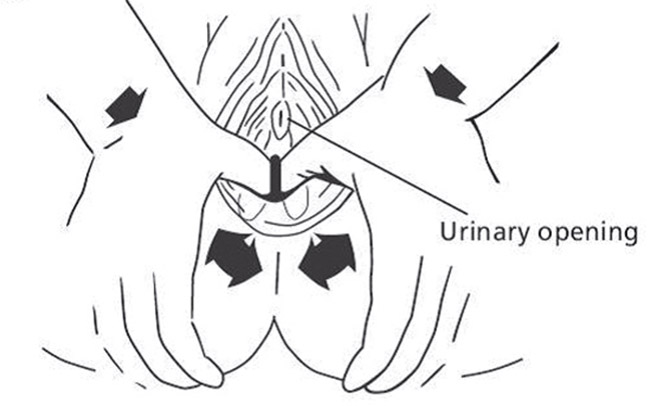
Diagram demonstarting hand positions when performing perineal massage Massaging the perineum (the area between the vagina and anus) in the later weeks of pregnancy has been shown to reduce the likelihood of tearing during birth, and of needing stitches or an episiotomy. You can start this from when you are 34 weeks pregnant and practice it daily/every other day until the birth of your baby. How to massage your perineum:
  • wash your hands
  • sit comfortably with your legs bent at the knees so you can reach your perineum easily. Use a mirror if you wish
  • massage oil (preferably vegetable-based) into the skin of the perineum using fingers and thumbs
  • place one or both thumbs inside your vagina and press downwards towards the anus. Move to each side in a U-shaped stretching movement. This may give a tingling/burning sensation
  • aim to massage the area inside the vagina, not necessarily just the skin on the outside
  • aim to apply the massage for five minutes.

Your baby’s movements

Your baby’s movements

Pregnant woman with a happy surprised expression looking down at her bump From 16-24 weeks on you should feel the baby move more and more up until 32 weeks, then stay roughly the same until you give birth. Take time to become familiar with your baby’s normal pattern of movements. You should continue to feel your baby move regularly right up until you give birth to him or her. The movements your baby makes offer reassurance that he or she is well, and therefore if you notice these movements change or reduce from what you are used to, it is important to call your midwife or attend the maternity unit urgently.
The importance of monitoring fetal movements
This video is available in many languages. Click on this link and scroll down to view the videos in English and other languages: The importance of monitoring fetal movements in 20 languages including sign language
Portal: Your baby’s movements

Getting to know your baby during pregnancy

Getting to know your baby during pregnancy

Pregnant woman smiling and holding a pair of baby shoes Taking time as part of your daily routine to think about and bond with your unborn baby is known to release oxytocin, a hormone which can help your baby’s brain to develop. Babies need adults to nurture and support their development during pregnancy and their speech, language and communication beyond birth. There is lots of helpful information to support you with chatting to your bump during pregnancy and talking, singing, playing and reading with your baby after birth. You can try:
  • talking, singing, playing and looking at books with your baby, and encouraging your partner/family/other children to do the same
  • gently massaging your bump
  • having a bath
  • trying pregnancy yoga
  • practising hypnobirthing
  • playing music to your baby
  • writing a letter to your baby
  • using an app to help you understand how your baby is growing and developing, such as the Baby Buddy App.
Building a relationship with your baby

Antenatal classes

Antenatal classes

Mothers-to-be and their birth partners attending a antenatal class Antenatal education (also known as birth preparation or parent craft classes) can help you to prepare for your baby’s birth, giving you confidence and information. You can attend these classes with your birthing partner so you can prepare together for the arrival of your baby. Antenatal education is also a good way to make friends with other parents who are expecting babies around the same time as you. These friendships can help parents through the first few months with their new baby. There are two types of class available to choose from:
  • free NHS antenatal classes available at your local maternity unit or children’s centre. Ask your midwife about these classes
  • private/independent antenatal classes.
Most antenatal classes can be started when you are around 28-32 weeks pregnant, but they can often get booked up in advance so it’s good to arrange your place early on. There are specialised antenatal classes for women expecting twins/triplets and your midwife or doctor will give you the information you need about these. Topics covered by antenatal classes include:
  • health in pregnancy, including a healthy diet
  • exercises to keep you fit and active during pregnancy
  • what happens during labour and birth
  • coping techniques for labour and information about pain relief
  • relaxation technique
  • information about the different modes of birth (vaginal, assisted with ventouse or forceps, caesarean)
  • caring for and feeding your baby
  • your health after giving birth
  • emotions and feelings during pregnancy, birth and after.
Classes can be attended by anyone – it doesn’t matter if it is your first baby or your fifth! A series of short videos have been created for those unable to attend classes in person:
Portal: Antenatal classes